
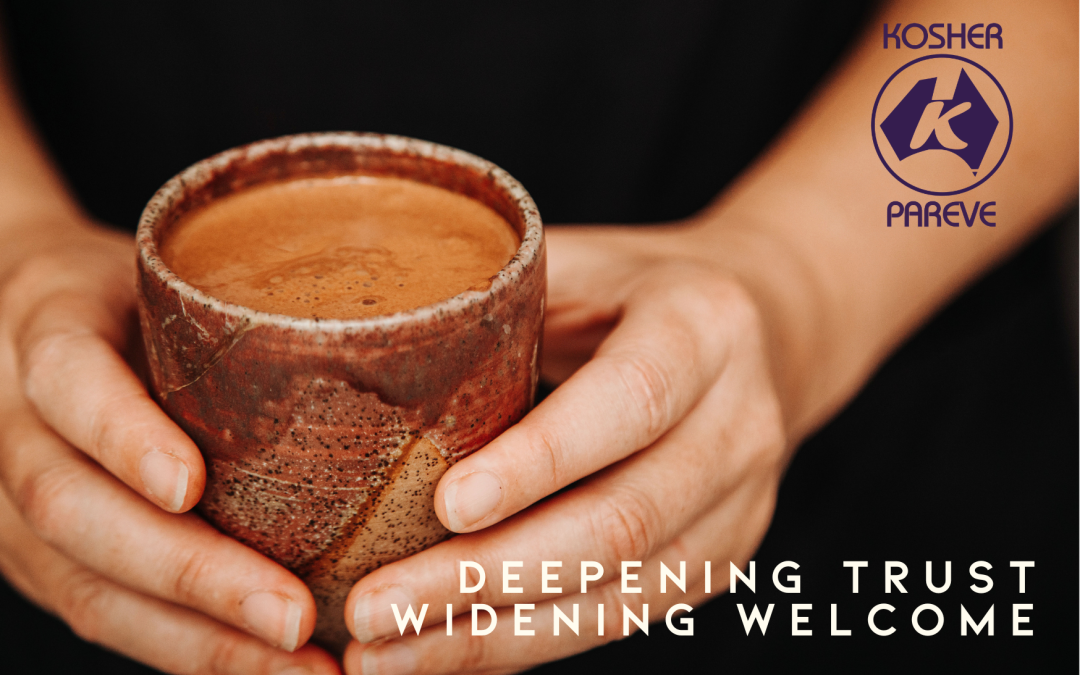
Across many cultures, food carries responsibility. The way we grow, prepare and share food reflects our relationship with one another.
Food is more than nourishment. It carries stories, traditions and connection. It carries the hands that grow it, the land it comes from and the communities who gather around it.
In Samoa, we understand this deeply. Food is an expression of connection – to the land, to family, to ancestors and to the people we share it with.
This understanding has always been at the heart of Living Koko.
From the cacao trees grown by farming families in Samoa, to the handcrafted chocolate and drinking cacao we make in Australia, every part of our journey is guided by respect.
Respect for the land.
Respect for people.
Respect for culture and tradition.
And respect for the food we create.
That is why we are proud to share that Living Koko is now Kosher Certified.
Why did Living Koko become Kosher Certified?
Our journey towards kosher certification actually began with a conversation.
Some new friends at Be Bowld asked whether Living Koko could become kosher certified and at several instore tastings many people would ask if our products were.
It was a question we were genuinely interested in exploring.
When we looked more closely at what kosher certification required, we discovered that many of the practices we had already built into our chocolate-making and food production processes aligned with kosher requirements. We were already incredibly careful about our ingredients, suppliers, production processes, cleaning procedures and traceability.
But there was an important difference between following good practices and having those practices independently verified…So we decided to take the next step.
We became officially Kosher Certified so that people who follow kosher dietary laws could enjoy Living Koko with confidence – and so that our wider community could see another layer of accountability behind the food we make.
What does kosher certification mean?
Kosher refers to food that complies with Jewish dietary laws, known as kashrut.
For a food manufacturer, kosher certification involves more than simply checking whether individual ingredients are suitable.
The certification process can include reviewing:
- Ingredients and ingredient suppliers
- Production and manufacturing processes
- Equipment and production areas
- Cleaning procedures
- Storage and handling
- Traceability and documentation
For Living Koko, this means our vegan chocolate and cacao products are produced within a certified system that has been independently reviewed according to kosher requirements. It is another way of giving our customers confidence in the care and integrity behind our products.
Is vegan chocolate automatically kosher?
This is a common question.
While Living Koko products are vegan and do not contain animal-derived ingredients, vegan and kosher are not the same certification.
A product can be vegan without being kosher certified.
Kosher certification considers not only the ingredients themselves, but also their sources, how they are handled, the equipment used and the processes involved in manufacturing.
This is why independent kosher certification provides an additional level of assurance.
For Living Koko, it complements the standards we already hold around ethical sourcing, ingredient transparency and responsible chocolate production.
More than a certification
We have never believed in making chocolate simply for the sake of making chocolate. We believe cacao is a relationship.
A relationship between the soil and the tree. Between the farmer and the harvest. Between the maker and the finished product. And between the person holding a warm cup of cacao and the moment they choose to slow down, connect and be present.
Our Samoan cacao carries a story that begins long before it reaches our kitchen in Australia.
We work with cacao farming communities in Samoa because we believe ethical chocolate should recognise the people and places behind every bean. For us, sustainability is not simply about packaging or production. It is about relationships, responsibility and thinking beyond the product in our hands.
Kosher certification is another part of that journey.
Creating a wider welcome
As Living Koko grows, we are learning that people have many different relationships with food.
For some, food choices are guided by sustainability. For others, ethical sourcing matters most. Some people choose vegan products. Others follow cultural, spiritual or religious food traditions that have been passed down through generations. We believe there should be room for all of these conversations.
Our goal is not to make everyone the same. – It is to create food that allows more people to gather around the same table.
That is why we are continuing to explore ways to make Living Koko more accessible to diverse communities while staying true to the values that have shaped us from the beginning.
Certifications that reflect our values
We don’t pursue certifications simply to collect logos. We pursue them because they represent commitments.
A commitment to transparency.
A commitment to quality.
A commitment to accountability.
And a commitment to listening to the communities we serve. Kosher certification is one step in our continuing journey to create ethical, sustainable and carefully crafted cacao that more people can enjoy with confidence.
Our journey began with Samoan cacao.
It continues through every farmer, maker, customer and community we connect with along the way.
Because at the heart of it all, cacao has always been about connection.
A shared cup.
A shared story.
A shared moment.
Certified with care. Created with integrity.
Frequently Asked Questions About Living Koko’s Kosher Certification
Is Living Koko chocolate kosher certified?
Yes. Living Koko is now Kosher Certified. Our ingredients and production processes have been reviewed as part of the certification process to ensure they meet kosher requirements.
Is Living Koko chocolate vegan?
Yes. Living Koko creates vegan chocolate and cacao products. Our vegan products are made without animal-derived ingredients.
Is vegan chocolate automatically kosher?
No. Vegan and kosher are different standards. Kosher certification considers ingredients as well as their sources, handling, equipment and manufacturing processes.
Why is kosher certification important for chocolate?
Kosher certification provides confidence for people who follow Jewish dietary laws and gives consumers additional assurance about ingredients, manufacturing processes and food production standards.
Where does Living Koko cacao come from?
Living Koko sources cacao from Samoa, PNG and Vanuatu,, working with cacao farming communities and transforming the beans into handcrafted chocolate and drinking cacao products in Australia.
Is kosher certification a religious blessing?
No. Kosher certification is a formal process of verifying that food and its production comply with Jewish dietary laws. It is not simply a blessing placed on a finished product.
Will Living Koko pursue other certifications?
We are continuing to listen to our community and explore ways to make Living Koko accessible to more people. Any future certifications will be considered carefully and will need to align with our commitment to quality, transparency, ethical sourcing and responsible food production.
From Samoa to the world
Living Koko began with a simple belief: that cacao can connect us.
Connect us to the land.
Connect us to the people who grow our food.
Connect us to culture and tradition.
And connect us to one another.
Becoming Kosher Certified is not a change in who we are.
It is another expression of who we have always aimed to be:
ethical, transparent, respectful and welcoming.
From the cacao trees of Samoa to communities around the world, we will continue creating cacao with care.
Certified with care. Created with integrity.