by Phoebe Preuss | Aug 18, 2026 | Chocolate manufacturers Melbourne, Uncategorized, Wellness Blogs
Yes. Like many plants, cacao can naturally contain trace amounts of metals that occur in soil and the wider environment.
That doesn’t mean cacao is unsafe.
It means that where cacao is grown, how it is cultivated and how it is tested matter.
At Living Koko, we believe you should know not only where your cacao comes from, but also what is in it.
So we recently sent our Head & Heart Drinking Cacao to an independent laboratory for testing for four metals:
- Cadmium
- Lead
- Mercury
- Nickel
The results gave us a clearer picture of our cacao — and we’re sharing the actual numbers with you.
Our cacao heavy metal testing results
Our Head & Heart sample was tested by Symbio Laboratories in Melbourne using ICP-MS analysis.
Here are the results:
| Metal |
Result |
| Cadmium (Cd) |
0.13 mg/kg |
| Lead (Pb) |
0.05 mg/kg |
| Mercury (Hg) |
<0.01 mg/kg |
| Nickel (Ni) |
7.91 mg/kg |
These are results from the particular sample submitted to the laboratory. They are not a claim that every batch of cacao will have exactly the same composition.
And that distinction matters.
Food testing is about measuring what is actually there — not making promises that nature cannot guarantee.
Why are heavy metals found in cacao?
The term “heavy metals” can sound frightening.
But some metals occur naturally in soil, water and plants.
Cacao trees absorb minerals and trace elements from the soil as they grow. Cadmium, in particular, can be taken up by cacao plants and stored in the leaves and seeds. Research into cacao has shown that soil and growing conditions can influence the amount of cadmium that ends up in cacao products.
This is one reason cacao origin matters.
Cacao isn’t simply a commodity that exists in a vacuum.
It comes from somewhere.
It grows in particular soil.
It is influenced by climate, farming practices and the surrounding environment.
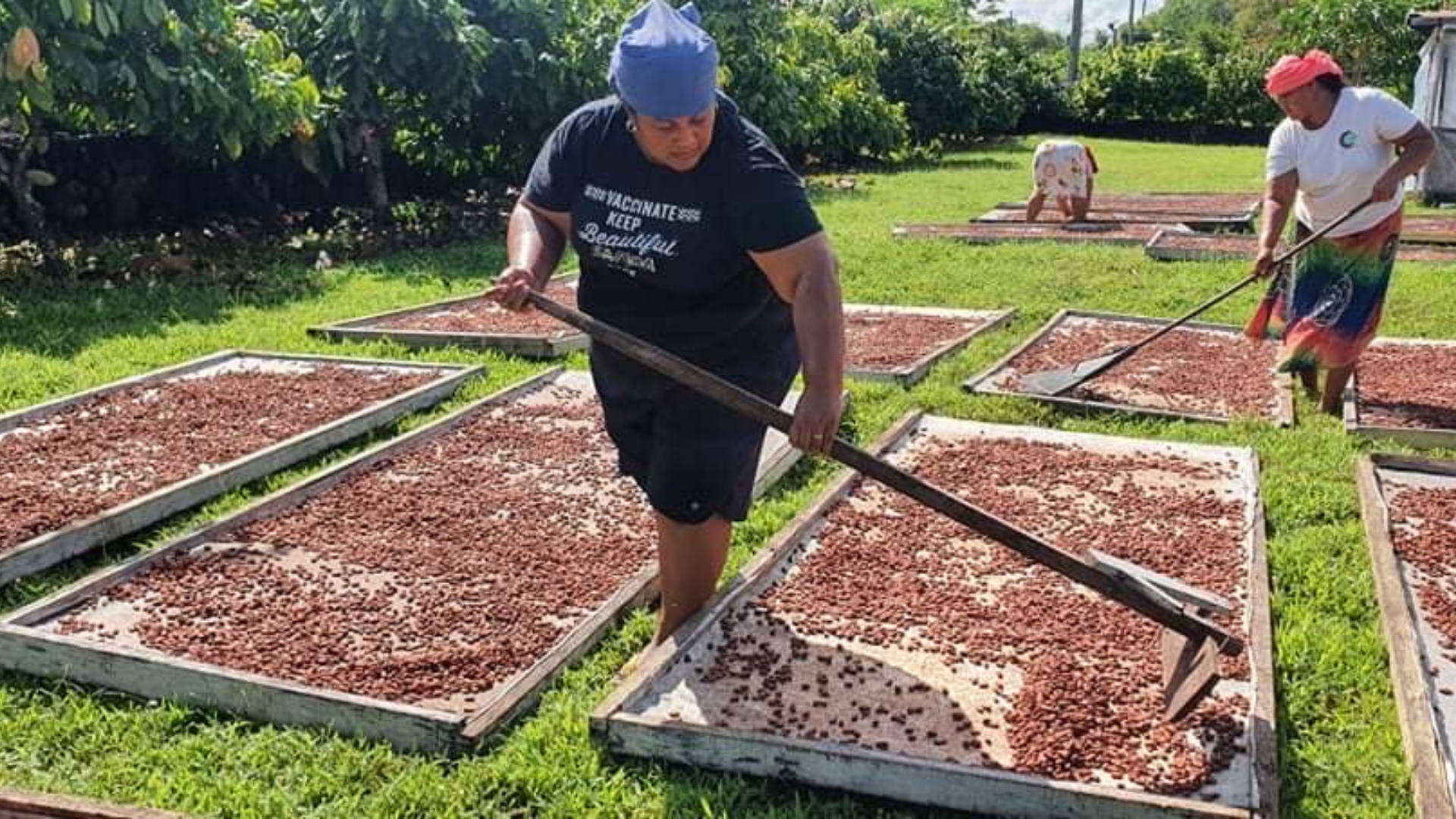
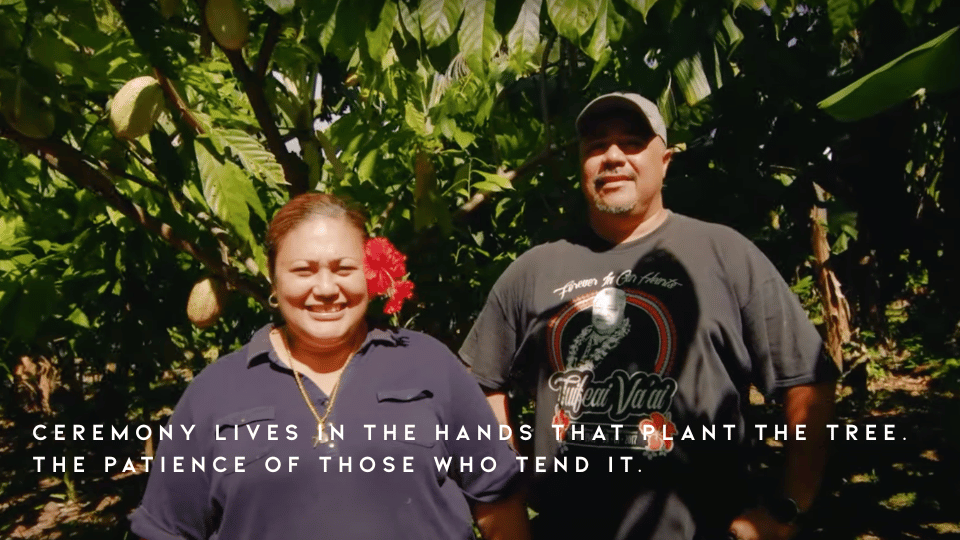
For Living Koko, our cacao journey begins with farmers and cacao trees in Samoa.
That connection to place is part of what makes our cacao special — and part of why responsible testing matters.
Cadmium in cacao: what did our testing show?
Cadmium is one of the metals that receives particular attention in cocoa and chocolate because cacao can naturally accumulate it from the soil.
Australia and New Zealand set a maximum level of 0.5 mg/kg for cadmium in chocolate and cocoa products under the Food Standards Code.
Our Head & Heart result was:
0.13 mg/kg
That’s approximately 74% below the Australian/New Zealand maximum level.
The European Union also regulates cadmium in cocoa products. Its maximum level for cocoa powder placed on the market for the final consumer, including cocoa powder used in drinking chocolate, is 0.60 mg/kg.
Our result of 0.13 mg/kg is approximately 78% below that EU maximum. (how awesome is that!!!)
That’s a result we’re pleased to see.
But we’re not going to turn one test into a grand claim that our cacao is somehow “free from heavy metals”.
Because it isn’t.
And that’s not how responsible food testing works.
What about lead in cacao?
Our lead result was:
0.05 mg/kg
Lead is an environmental contaminant that food producers take seriously.
We tested for it because we want to understand the broader contaminant profile of our cacao, rather than looking at only one number.
Our laboratory measured 0.05 mg/kg of lead in the Head & Heart sample.
We think there’s value in simply telling you the result.
No dramatic headline.
No “zero heavy metals” claim.
Just the number.
What does this mean in a normal serving?
Our Head & Heart cacao tested at 0.05 mg/kg of lead. The European Union sets a maximum permitted level of 0.60 mg/kg for cocoa powder sold to consumers, including cocoa powder used in drinking chocolate.
Our result is therefore well below the EU maximum — approximately 92% lower than the permitted level. This is something massive to celebrate!!!
Looking at it from a normal serving perspective, a 30 g serving of Head & Heart contains approximately 1.5 micrograms (µg) of lead. The EU limit of 0.60 mg/kg would correspond to 18 µg of lead in a 30 g serving.
Lead is an environmental contaminant, so we don’t claim that our cacao contains “zero lead” — our testing found a small, measurable amount. Instead, we think the useful thing is to show you the actual result and put it into context: 0.05 mg/kg in the product, or approximately 1.5 µg in a 30 g serving, compared with the EU maximum of 0.60 mg/kg for drinking chocolate.
No dramatic headline. No “zero heavy metals” claim. Just the number, the standard, and the context.
What about mercury in cacao?
Our mercury result was reported as:
<0.01 mg/kg
This means the mercury level was below the laboratory’s reporting limit of 0.01 mg/kg. It does not mean that mercury was necessarily completely absent — simply that it was below the level the laboratory could reliably report as a quantified result.
To put this into the context of a normal serving, if mercury were present at the laboratory’s reporting limit of 0.01 mg/kg, a 30 g serving would contain less than 0.0003 mg — or less than 0.3 micrograms (µg) — of mercury.
Unlike lead, there isn’t a specific EU maximum level for mercury in cocoa or drinking chocolate that we can use as a direct comparison. So rather than creating a misleading “safe limit” comparison, we’re sticking with what our laboratory actually reported.
Mercury: <0.01 mg/kg.
A 30 g serving: <0.3 µg.
Again, we’re sharing the laboratory’s wording rather than turning a below-reporting-limit result into a stronger claim than the science supports.
What about nickel in cacao?
A few weeks ago I had a wonderful community member ask us about Nickel at a Melbourne instore tasting, this isn’t usually something we test as chocolate makers but because he was monitoring this due to heavy metals in his own body we decided to go out and get this checked with our labs again to understand what our snapshot is right now.
Nickel was the highest of the four metals tested:
7.91 mg/kg
This is where some important context is needed.
There isn’t a simple Australia/New Zealand or EU maximum level for nickel in cacao equivalent to the specific cadmium limits above.
So we don’t think it would be responsible to invent a “safe” or “unsafe” threshold and present it as a regulatory standard.
Nickel occurs naturally in many plant foods.
The concentration in a food is only one part of understanding exposure. How much of the food is consumed also matters.
For us, this result means monitoring, learning and continuing to test — not fear.
What does this mean in a normal serving?
At the tested concentration of 7.9 mg of nickel per kilogram, a 30 g serving of cacao contains approximately 0.237 mg (237 micrograms) of nickel. For context, the 1 mg (1,000 microgram) adult upper intake level sometimes referenced in scientific literature represents a general upper intake level for adults for soluble nickel salts — it is not a legal limit for nickel in food. A 30 g serving of our cacao therefore contains approximately 24% of that 1 mg reference value. Nickel occurs naturally in many plant foods, including cacao, nuts, legumes and grains, and only a fraction of dietary nickel is absorbed into the bloodstream. For the general population, nickel exposure is best considered in the context of overall dietary intake, while people with nickel sensitivity or allergy may need individual dietary guidance.
Is ceremonial cacao safe?
This is a question we hear more and more as ceremonial cacao becomes increasingly popular.
The honest answer is that “ceremonial cacao” is not, by itself, a scientific guarantee of safety or a particular contaminant level.
What matters is the cacao itself, its source, how it has been processed, the product formulation and appropriate food-safety testing.
At Living Koko, we don’t believe a beautiful story about cacao should replace good food science.
We want both.
The story matters.
The farmers matter.
The land matters.
And the testing matters too.
Why testing cacao matters
Cacao is a plant.
Plants grow in soil.
Soil contains naturally occurring minerals and trace elements.
That is simply part of agriculture.
The question isn’t whether we can make nature disappear.
The question is whether we understand what we’re working with.
That’s why independent testing is valuable.
It gives us information we cannot get from looking at a cacao bean, smelling it or tasting it.
And it allows us to make decisions based on evidence rather than assumption.
Our laboratory report also makes an important point: where samples are supplied by the customer, the results apply to the samples as received and responsibility for representative sampling rests with the customer.
For us, that means one laboratory report is a snapshot, not the end of the story.
We want to build a longer history of testing across representative batches of our cacao.
From Samoan soil to your cup
There is something beautiful about knowing where your food comes from.
Our cacao begins with farmers in Samoa.
It grows from the earth.
It is harvested, fermented and processed.
And eventually, it becomes something very simple:
A warm cup of cacao between your hands.
That journey deserves care at every stage.
For us, ethical cacao isn’t only about the relationship between farmer and buyer.
It is also about stewardship.
Of the land.
Of the cacao.
Of the people who grow it.
And of the people who drink it.
Our approach to cacao testing
We don’t believe in using science as a marketing trick.
We believe in using it as a tool for better making.
That means:
We test.
We measure.
We learn.
We keep improving.
And when we have information that our customers may reasonably want to know, we’d rather share the actual numbers than hide behind vague language.
Our latest Head & Heart results showed:
Cadmium — 0.13 mg/kg
Lead — 0.05 mg/kg
Mercury — <0.01 mg/kg
Nickel — 7.91 mg/kg
Our cadmium result is comfortably below the Australian/New Zealand maximum level for chocolate and cocoa products and below the EU maximum for cocoa powder and drinking chocolate.
And that’s worth celebrating.
Not because it means our work is finished.
But because it gives us another piece of evidence that the care we put into our cacao is heading in the right direction.
Good cacao should taste beautiful.
But we believe it should also be made with care.
From Samoan soil to your cup.
That’s Living Koko.
by Phoebe Preuss | Aug 10, 2026 | Chocolate manufacturers Melbourne, Uncategorized, Wellness Blogs
Across many cultures, food carries responsibility. The way we grow, prepare and share food reflects our relationship with one another.
Food is more than nourishment. It carries stories, traditions and connection. It carries the hands that grow it, the land it comes from and the communities who gather around it.
In Samoa, we understand this deeply. Food is an expression of connection – to the land, to family, to ancestors and to the people we share it with.
This understanding has always been at the heart of Living Koko.
From the cacao trees grown by farming families in Samoa, to the handcrafted chocolate and drinking cacao we make in Australia, every part of our journey is guided by respect.
Respect for the land.
Respect for people.
Respect for culture and tradition.
And respect for the food we create.
That is why we are proud to share that Living Koko is now Kosher Certified.
Why did Living Koko become Kosher Certified?
Our journey towards kosher certification actually began with a conversation.
Some new friends at Be Bowld asked whether Living Koko could become kosher certified and at several instore tastings many people would ask if our products were.
It was a question we were genuinely interested in exploring.
When we looked more closely at what kosher certification required, we discovered that many of the practices we had already built into our chocolate-making and food production processes aligned with kosher requirements. We were already incredibly careful about our ingredients, suppliers, production processes, cleaning procedures and traceability.
But there was an important difference between following good practices and having those practices independently verified…So we decided to take the next step.
We became officially Kosher Certified so that people who follow kosher dietary laws could enjoy Living Koko with confidence – and so that our wider community could see another layer of accountability behind the food we make.
What does kosher certification mean?
Kosher refers to food that complies with Jewish dietary laws, known as kashrut.
For a food manufacturer, kosher certification involves more than simply checking whether individual ingredients are suitable.
The certification process can include reviewing:
- Ingredients and ingredient suppliers
- Production and manufacturing processes
- Equipment and production areas
- Cleaning procedures
- Storage and handling
- Traceability and documentation
For Living Koko, this means our vegan chocolate and cacao products are produced within a certified system that has been independently reviewed according to kosher requirements. It is another way of giving our customers confidence in the care and integrity behind our products.
Is vegan chocolate automatically kosher?
This is a common question.
While Living Koko products are vegan and do not contain animal-derived ingredients, vegan and kosher are not the same certification.
A product can be vegan without being kosher certified.
Kosher certification considers not only the ingredients themselves, but also their sources, how they are handled, the equipment used and the processes involved in manufacturing.
This is why independent kosher certification provides an additional level of assurance.
For Living Koko, it complements the standards we already hold around ethical sourcing, ingredient transparency and responsible chocolate production.
More than a certification
We have never believed in making chocolate simply for the sake of making chocolate. We believe cacao is a relationship.
A relationship between the soil and the tree. Between the farmer and the harvest. Between the maker and the finished product. And between the person holding a warm cup of cacao and the moment they choose to slow down, connect and be present.
Our Samoan cacao carries a story that begins long before it reaches our kitchen in Australia.
We work with cacao farming communities in Samoa because we believe ethical chocolate should recognise the people and places behind every bean. For us, sustainability is not simply about packaging or production. It is about relationships, responsibility and thinking beyond the product in our hands.
Kosher certification is another part of that journey.
Creating a wider welcome
As Living Koko grows, we are learning that people have many different relationships with food.
For some, food choices are guided by sustainability. For others, ethical sourcing matters most. Some people choose vegan products. Others follow cultural, spiritual or religious food traditions that have been passed down through generations. We believe there should be room for all of these conversations.
Our goal is not to make everyone the same. – It is to create food that allows more people to gather around the same table.
That is why we are continuing to explore ways to make Living Koko more accessible to diverse communities while staying true to the values that have shaped us from the beginning.
Certifications that reflect our values
We don’t pursue certifications simply to collect logos. We pursue them because they represent commitments.
A commitment to transparency.
A commitment to quality.
A commitment to accountability.
And a commitment to listening to the communities we serve. Kosher certification is one step in our continuing journey to create ethical, sustainable and carefully crafted cacao that more people can enjoy with confidence.
Our journey began with Samoan cacao.
It continues through every farmer, maker, customer and community we connect with along the way.
Because at the heart of it all, cacao has always been about connection.
A shared cup.
A shared story.
A shared moment.
Certified with care. Created with integrity.
Frequently Asked Questions About Living Koko’s Kosher Certification
Is Living Koko chocolate kosher certified?
Yes. Living Koko is now Kosher Certified. Our ingredients and production processes have been reviewed as part of the certification process to ensure they meet kosher requirements.
Is Living Koko chocolate vegan?
Yes. Living Koko creates vegan chocolate and cacao products. Our vegan products are made without animal-derived ingredients.
Is vegan chocolate automatically kosher?
No. Vegan and kosher are different standards. Kosher certification considers ingredients as well as their sources, handling, equipment and manufacturing processes.
Why is kosher certification important for chocolate?
Kosher certification provides confidence for people who follow Jewish dietary laws and gives consumers additional assurance about ingredients, manufacturing processes and food production standards.
Where does Living Koko cacao come from?
Living Koko sources cacao from Samoa, PNG and Vanuatu,, working with cacao farming communities and transforming the beans into handcrafted chocolate and drinking cacao products in Australia.
Is kosher certification a religious blessing?
No. Kosher certification is a formal process of verifying that food and its production comply with Jewish dietary laws. It is not simply a blessing placed on a finished product.
Will Living Koko pursue other certifications?
We are continuing to listen to our community and explore ways to make Living Koko accessible to more people. Any future certifications will be considered carefully and will need to align with our commitment to quality, transparency, ethical sourcing and responsible food production.
From Samoa to the world
Living Koko began with a simple belief: that cacao can connect us.
Connect us to the land.
Connect us to the people who grow our food.
Connect us to culture and tradition.
And connect us to one another.
Becoming Kosher Certified is not a change in who we are.
It is another expression of who we have always aimed to be:
ethical, transparent, respectful and welcoming.
From the cacao trees of Samoa to communities around the world, we will continue creating cacao with care.
Certified with care. Created with integrity.